
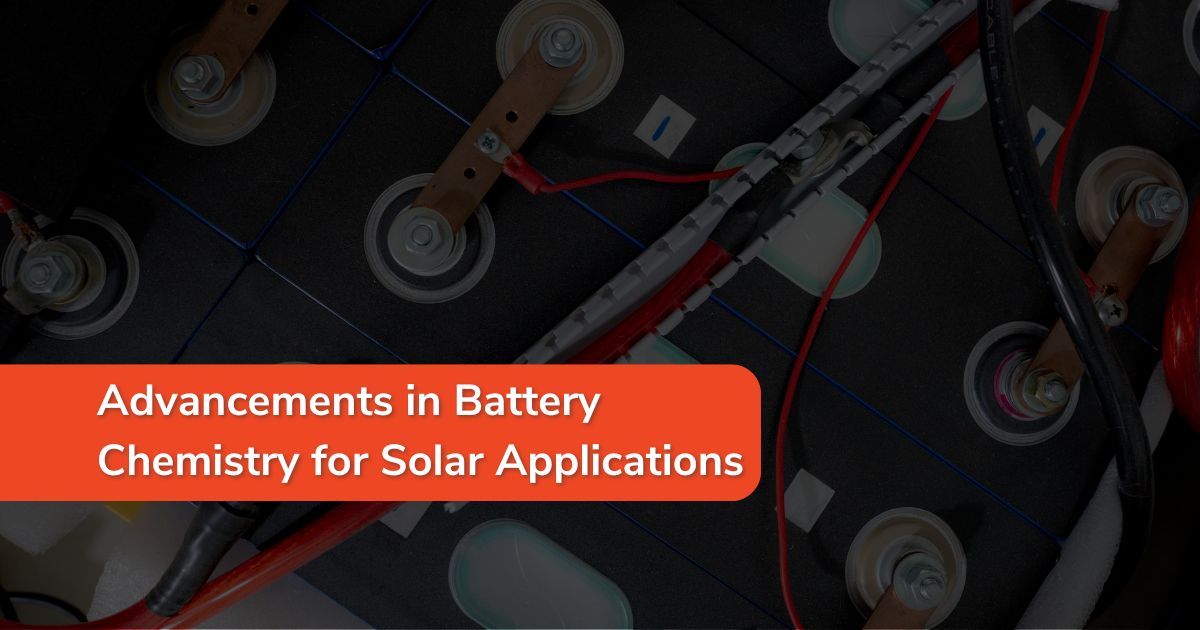
The Australian solar landscape is evolving, and nowhere is this more apparent than in the dynamic advancements of battery chemistry within the solar energy industry.
As the world seeks sustainable and efficient power solutions, the role of cutting-edge battery technology cannot be overstated.
This blog post dives deep into the intricacies of battery chemistry, exploring not just the science but also the practical impact of the latest innovations in solar applications.
Before we can grasp the significance of advancements, it is vital to understand the fundamental battery chemistries at play in solar applications.
These chemistries, though diverse, share a common goal: to store the energy harvested by solar panels for later use.
Historically significant in the storage of solar energy, lead-acid batteries are renowned for their robustness and cost efficiency.
The simple chemical reaction between lead dioxide, sulphuric acid, and lead provides a reliable means of energy storage, albeit with limitations in cycle life and energy density.
Lithium-ion, or Li-ion, batteries have revolutionised energy storage with superior energy density and longer cycle life compared to lead-acid batteries.
They operate on the transfer of lithium ions between the positive and negative electrode materials, typically graphite and a high-energy cathode, during charge and discharge.
Flow batteries conceptually differ from traditional Li-ion technology.
They use vanadium dissolved in an acid electrolyte, with the energy storage taking place in two separate tanks, making the battery’s energy capacity and power independent of each other.
Solid-state batteries, an exciting frontier in solar applications, avoid the liquid electrolytes of traditional batteries in favour of solid electrolytes.
This offers the potential for safer, denser, and more robust energy storage devices.
With the basics in our arsenal, we now explore the significant strides being made in battery chemistry and what they mean for solar in Australia.
Lithium-ion batteries continue to see advancements not just in energy density, which is crucial for increasing the amount of renewable energy that can be effectively stored, but also in safety features.
These include solid ceramic electrolytes that help prevent the growth of dendrites, which can cause short circuits.
Solid-state batteries present the possibility of an order-of-magnitude jump in energy density due to the elimination of flammable liquid components and the use of lithium metal anodes.
Furthermore, solid-state design may allow for wider temperature ranges, a critical factor for solar applications in variable environments.
Flow batteries, with a focus on decoupling power and energy, offer extended cycle life and are not as susceptible to performance degradation over time as Li-ion batteries.
This technology may prove pivotal in storing solar energy for long durations, a key requirement for grid stability.
Advanced battery chemistries are not mere theoretical concepts.
They have tangible impacts on the efficacy and sustainability of solar energy systems.
The most immediate impact is expanded storage capacity.
Batteries built on advanced chemistries can store more energy in less space, which is critical for residential applications where space is a premium.
Lithium-ion’s high charge and discharge efficiency translates to lower energy losses, especially when coupled with solar panels.
Additionally, the ability of smart batteries to learn usage patterns and optimise charging and discharging further boosts performance.
As advancements drive down costs, solar with storage becomes more accessible.
Homeowners in Australia can now equip systems that harness renewable energy and reduce dependency on the grid, even during peak demand hours.
To understand the practical implications of advanced battery chemistry, case studies provide crucial insights.
Remote Australian communities that were once reliant on expensive and environmentally harmful diesel generators are now turning to solar paired with advanced batteries to ensure a reliable power supply.
Residential properties with solar and storage solutions are achieving unprecedented energy independence.
Not only are they minimising their carbon footprint, but they’re also gaining a degree of power security that was once the preserve of large corporations.
Large-scale solar installations, coupled with cutting-edge storage solutions, are poised to transform the industrial sector.
They offer clean and reliable power, reduce operational costs, and contribute to a greener economy.
As we gaze towards the horizon, the potential for even more transformative battery technologies is compelling.
Lithium, though the current poster child of battery chemistry, is not the only contender for the future.
Research into post-lithium technologies like sodium, zinc, and even organic compounds could further diversify the energy storage landscape.
As electric vehicles, or EVs, proliferate, the synergy between EV batteries and solar systems presents yet another avenue for sustainable power solutions.
The bidirectional charging capability of future EVs could turn them into mobile energy storage units, enhancing grid stability.
Australia’s unique energy challenges and abundance of renewable resources position it as a crucible for innovation in solar battery technology.
Market leaders including SolarEdge and Tesla are at the forefront, developing and deploying solutions that are shaping the future of solar energy, not just in the country, but globally.
Understanding the trajectory of battery technology allows Australian consumers to make informed decisions about embracing solar.
It’s an exciting time to harness the power of the sun, converting it into clean, reliable, and efficient energy to power our everyday lives.
For Australians considering a switch to solar energy, the message is clear: advanced battery technology like the SolarEdge Home Battery and Tesla Powerwall can make your solar investment more effective and future-proof.
Its efficiency, stacking capability, and robust safety features set new standards for domestic solar storage solutions.
With the right solar and storage solution, energy independence is within reach for many Australians.
SolarEdge’s innovative technologies are not only meeting but exceeding the demands of modern solar applications, allowing homeowners to take control of their energy production and usage.
In conclusion, the confluence of battery chemistry advancements and solar applications heralds a new dawn in the Australian energy sector.
Embracing these changes not only offers environmental benefits but also economic and practical ones.
The call to action for Australians is to explore these solutions actively, as they not only shape individual energy consumption but also contribute to the grand narrative of a sustainable future for the nation and the world.