
As solar energy becomes increasingly popular for homes and businesses, understanding its terminology is crucial.
One common area of confusion is differentiating between kilowatts, or kW, and kilowatt-hours, or kWh.
But that’s not all.
There are several other important terms to know.
Let’s dive in to help you navigate solar energy with confidence and make informed decisions.
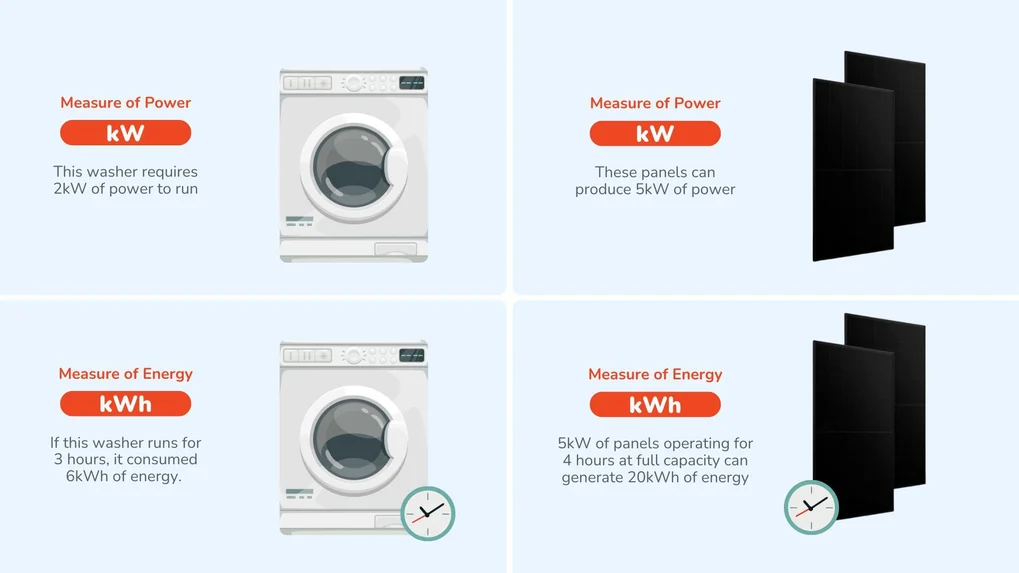
A kilowatt, or kW, is a measurement unit of power that indicates the rate at which energy is generated or consumed at any given moment.
For example:
Think of kilowatts as the capacity or strength of a system or appliance.
It tells you how much energy can flow at a specific time.
A kilowatt-hour, or kWh, measures how much energy is used or produced over time.
This is what you see on your electricity bill.
For example:
While kW measures instantaneous power, kWh accounts for energy over a specific period.
Confusing kilowatts, or kW, and kilowatt-hours, or kWh, can lead to costly mistakes when selecting a solar panel system.
Interchanging these terms might result in purchasing a system that is either too large or too small for your needs.
To determine the appropriate solar system size, start by examining your daily energy usage, measured in kWh, which can be found on your electricity bill.
Once you know your average daily consumption, you can calculate the required system capacity, measured in kW, to generate enough energy to meet your needs.
By understanding the relationship between kW and kWh, you can ensure you choose the right solar panel system size for your energy requirements.
When it comes to batteries, two specifications are critical:
For instance, a battery with 10kWh capacity and 5kW output can store enough energy for night-time use but has a maximum power limit of 5kW for appliances running at the same time.
This battery will fully discharge within two hours if used at full power.
To choose the right battery, balance storage capacity with power output to meet your household’s energy and peak power demands.
Here are additional terms to know that impact the performance and reliability of solar systems:
Having a clear understanding of solar energy terminology is essential for anyone considering solar power.
Here’s why it matters:
When considering solar energy, consult with trusted professionals to guide you through the process.
A well-informed decision ensures your system is tailored to your energy needs, helping you achieve energy independence and long-term savings.
At Smart Energy Answers, Australia’s leading, award-winning provider of smart solar solutions, we’ve helped over 7,000 customers transition to renewable energy with systems designed for optimal performance and savings.
With over 700 five-star reviews, you can trust us to deliver exceptional service and expertise every step of the way.
Take the first step toward a sustainable future today.
Contact Smart Energy Answers for a free consultation and discover the perfect solar solution for your home or business.