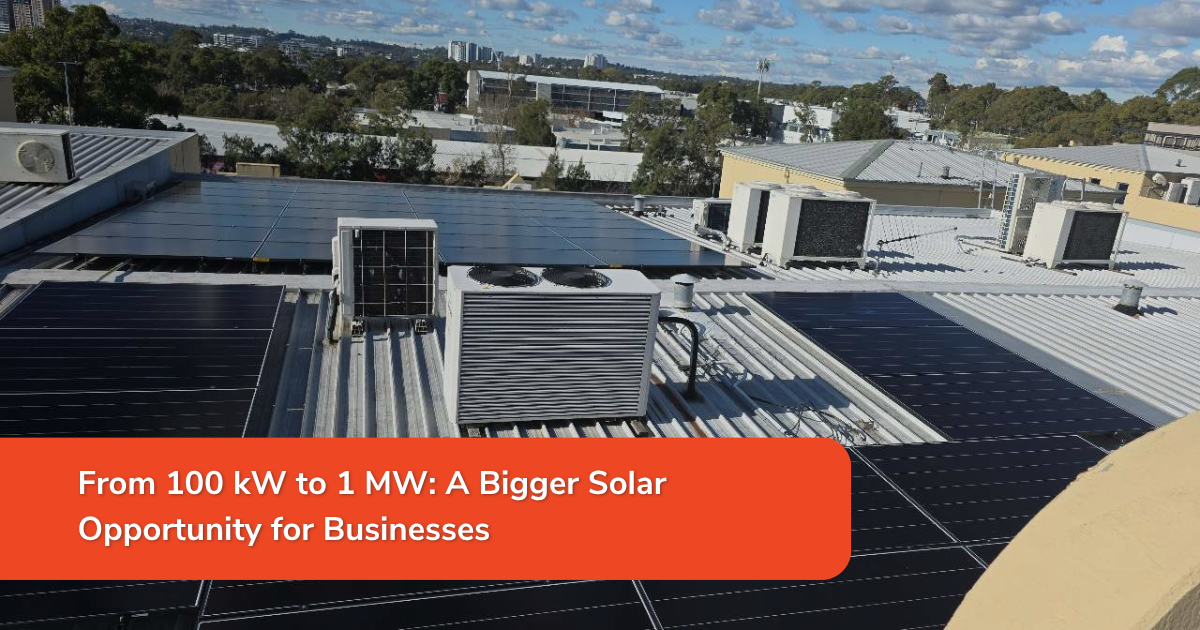
Previously, the SRES generally supported solar PV systems up to 100 kW, while larger projects were treated under the Large-scale Renewable Energy Target (LRET). The expansion creates a new opportunity for businesses, farms, warehouses, manufacturers, logistics facilities, schools, hospitals and community organisations considering larger onsite solar systems.
For businesses, the change is significant because a much larger portion of commercial rooftop solar projects can now potentially receive an upfront financial benefit through Small-scale Technology Certificates (STCs).
At a glance: Australia’s new mid-scale solar opportunity
| |
New SRES mid-scale solar support
|
|
Starts
|
1 October 2026
|
|
Eligible system size
|
Above 100 kW to 1 MW
|
|
Support mechanism
|
Small-scale Technology Certificates (STCs)
|
|
Deeming period
|
Fixed 5-year deeming period, applied annually through to 2030
|
|
Who may benefit?
|
Businesses, farms, community organisations and other eligible sites
|
|
Administered by
|
Clean Energy Regulator
|
|
STC applications
|
Expected to open mid-to-late November 2026
|
|
Maximum new system size
|
1 MW
|
|
Existing systems/expansions
|
Total onsite capacity must not exceed 1 MW under the relevant rules
|
The Clean Energy Regulator says eligible systems installed from 1 October will be able to apply for STCs once applications open, which is currently expected in mid-to-late November 2026.
Why does the 1 MW solar expansion matter to businesses?
The previous 100 kW SRES limit could leave many larger energy users outside the scheme’s upfront support.
A warehouse, manufacturing facility, retail site or agricultural operation might have enough roof space and electricity demand to justify a 200 kW, 300 kW, 500 kW or larger solar system. The new rules extend SRES eligibility into this “mid-scale” range, potentially making a larger solar investment more financially attractive.
The Australian Government estimates that expanding the SRES could reduce upfront installation costs for eligible commercial, industrial and agricultural systems by around 20%, although the actual benefit for an individual project will depend on factors including system size, STC value and project circumstances.
In other words, businesses that previously had to evaluate a larger solar project without SRES support now have another financial factor to consider.
How does the new SRES support work for 100 kW to 1 MW solar?
The support is delivered through Small-scale Technology Certificates, or STCs.
For eligible mid-scale solar, the STC calculation uses a five-year deeming period each year through to 2030. This differs from the standard small-scale solar arrangements, where the deeming period declines as the scheme moves towards 2030.
In practical terms, the certificates have financial value and can generally be incorporated into the project’s upfront economics. Businesses should ask their installer or certificate agent how the STC benefit will be factored into their project quotation.
Applications will be assessed against the applicable eligibility requirements.
What could the financial benefit look like?
Government modelling provides some useful examples.
For a 250 kW solar PV installation, the Australian Government estimates an STC-related discount of approximately $68,000.
For a 500 kW installation, the estimated discount is approximately $136,000.
These are government estimates rather than guaranteed discounts. The actual value available to a particular project can vary, so businesses should obtain a project-specific assessment rather than applying these figures directly to their own budget.
What types of businesses could benefit from 1 MW solar?
The expansion is particularly relevant to businesses with substantial electricity consumption and suitable roof or site space.
Potential applications include:
Warehouses and logistics centres
Large warehouse roofs can provide substantial areas for solar generation, while daytime operations can create significant onsite electricity demand.
Manufacturing and industrial facilities
Manufacturers often have energy-intensive equipment operating during daylight hours. A larger solar system can help generate electricity closer to where it is consumed.
Agriculture and food processing
Farms and agricultural processing facilities can have substantial energy requirements from refrigeration, pumps, processing equipment and other operations.
Retail and commercial properties
Shopping centres, large retail sites and commercial facilities can potentially use rooftop solar to offset daytime electricity consumption.
Schools, hospitals and community facilities
The SRES expansion also covers eligible community infrastructure, opening opportunities for larger solar installations beyond traditional small commercial systems.
Does a 1 MW solar system have to be installed on a business rooftop?
Not necessarily.
The expansion is designed to support eligible mid-scale solar PV systems, including projects across commercial, industrial, agricultural and community settings.
However, the project still needs to meet applicable planning, electrical, installation and network requirements. For businesses, the practical feasibility of a 1 MW system will depend on factors such as available roof or site area, structural considerations, electricity consumption, network connection requirements and site-specific approvals.
The Clean Energy Regulator specifically notes that eligible projects must comply with applicable local, state, territory and federal requirements, as well as relevant network connection agreements.
Can an existing solar system be expanded to 1 MW?
Potentially, but this is an area where businesses need to be particularly careful.
The new rules allow eligible expansions where the maximum total onsite capacity is 1 MW, subject to the applicable requirements.
This means businesses with existing solar should not simply assume that adding panels will automatically qualify for the new SRES support.
The project’s existing generation equipment, new equipment, site capacity, approvals, network connection and previous certificate claims may all need to be assessed. The Clean Energy Regulator has published transitional guidance specifically for businesses and project developers planning or progressing mid-scale solar projects.
If you’re considering expanding an existing commercial solar system, have the entire site assessed before committing to the project.
What are the key eligibility requirements?
Eligible mid-scale solar projects need to satisfy a range of requirements.
These include:
- System capacity above 100 kW and no more than 1 MW.
- Accredited installation and product requirements under the SRES.
- Compliance with applicable Australian electrical safety requirements.
- Compliance with relevant planning and approval requirements.
- Compliance with network connection requirements.
- Required installer documentation and written statements.
- Supporting evidence demonstrating that planning and approval requirements have been met.
The Clean Energy Regulator is continuing to provide guidance around areas such as system boundaries, existing systems, extensions and the application process.
What about solar systems larger than 1 MW?
The SRES expansion does not mean every commercial solar project is moving into the SRES. The new mid-scale category extends SRES eligibility to systems above 100 kW and up to 1 MW. Projects larger than 1 MW remain within the large-scale renewable energy framework, subject to the applicable LRET requirements. Existing large-scale systems supported under the LRET continue under that scheme. For businesses considering a system close to or above 1 MW, the distinction is therefore important during the early design and feasibility stage.
What should businesses do from October 1st 2026?
If your business has been considering a larger solar installation, the SRES expansion is worth including in your project planning now.
1. Review your electricity usage
Look at your electricity bills and interval data to understand when your business consumes the most energy.
2. Assess your available solar capacity
Your roof, car park or other suitable site areas may have considerably more solar potential than a 100 kW system.
3. Determine the right system size
Don’t choose 1 MW simply because it is the new maximum. The right system should reflect your energy consumption, available space, network constraints and financial objectives.
4. Assess the SRES opportunity
An accredited provider can assess whether the proposed system meets the relevant SRES requirements and estimate the potential STC benefit.
5. Start network and project planning early
Commercial solar projects can involve engineering, approvals, network studies and connection requirements. The Clean Energy Regulator notes that projects of this size can take significant time from design through approval, making early planning important.
Is this the right time to consider commercial solar? For businesses that previously sat just above the 100 kW SRES threshold, 1 October 2026 creates a new opportunity to revisit the numbers. A larger solar system can potentially make better use of available roof space, generate more electricity onsite and reduce the amount of power a business needs to purchase from the grid. The new SRES support adds another factor to that financial equation. But the right system size will depend on the individual business. A 250 kW system may make sense for one operation, while another may benefit from 500 kW, 800 kW or a smaller installation. The important step is to assess the project around energy consumption, solar generation, network capacity, available space and the applicable SRES benefit together. What does the SRES expansion mean for commercial solar in Australia?
The expansion effectively opens a new middle ground between traditional small-scale rooftop solar and larger utility-style renewable energy projects. For Australian businesses, that could mean:
- Larger eligible solar systems, support now extends beyond the previous 100 kW threshold.
- Potentially lower upfront costs, eligible systems can receive financial support through STCs.
- Better use of commercial rooftops, larger sites can consider systems more closely aligned with their electricity demand.
- More opportunities for energy-intensive businesses, manufacturing, logistics, agriculture and other sectors can assess larger onsite systems.
- A stronger business case for solar, the STC benefit can be considered alongside electricity savings and other project economics.
The expansion does not make every 1 MW project automatically viable or eligible. But for businesses that have previously looked at commercial solar and found themselves outside the SRES threshold, it provides a new reason to revisit the numbers. Frequently Asked Questions