
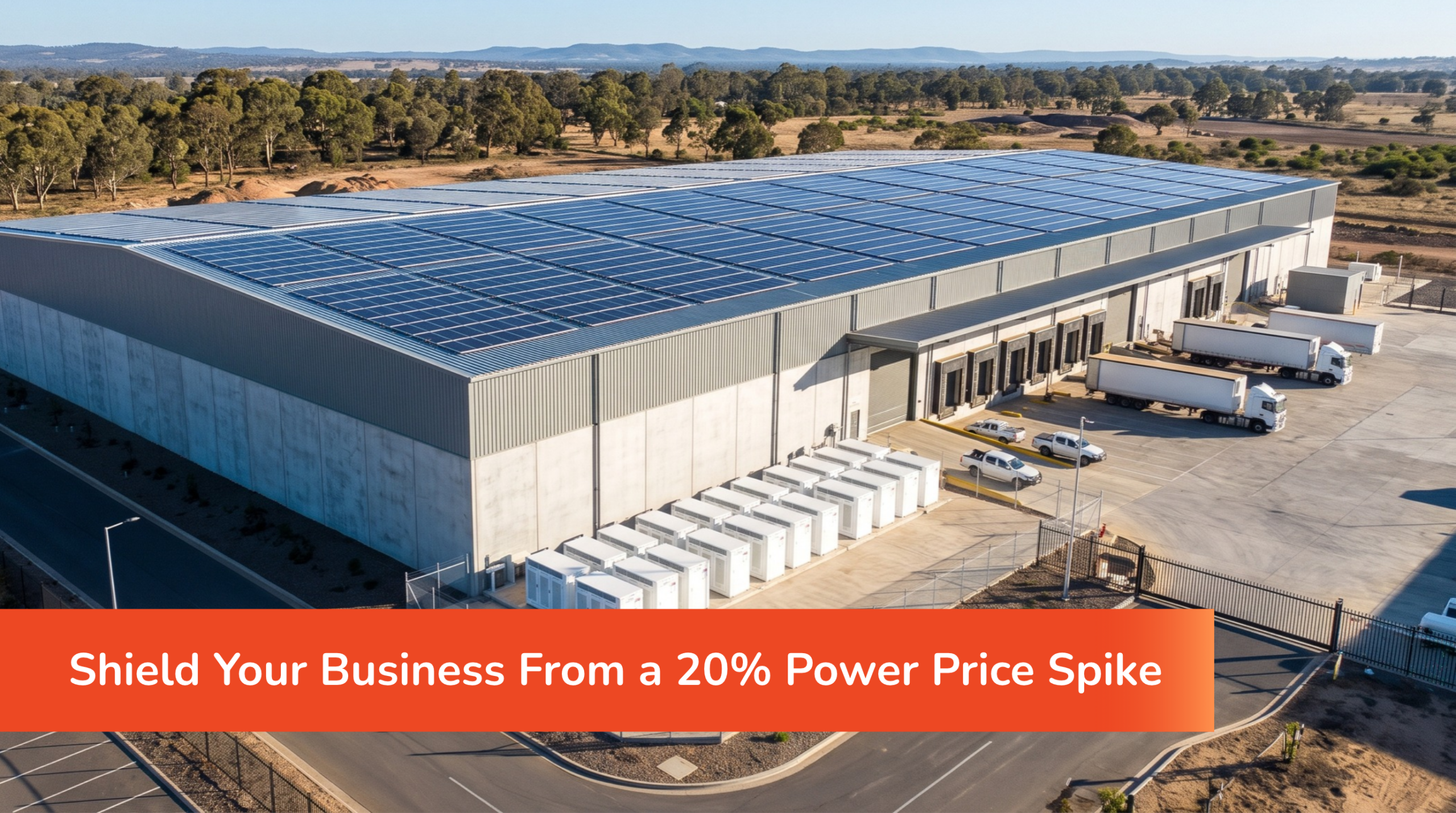
A new report released on 19 November 2026 warns that wholesale electricity prices in Australia could rise by around 20% in less than a decade if the country follows the path the United States has taken with data centres. The modelling comes from the Climate Council and Carbon Zero Initiative. It is a scenario, not a forecast, and it applies to wholesale prices rather than to every line on your bill.
Still, the signal matters for any business that buys electricity. Data centre demand is growing quickly, new renewable generation can take five to ten years to build, and the wholesale price is one of the biggest parts of what many businesses pay.
Short answer: Power prices are not locked in to rise by 20%. The risk depends on whether new supply is built in time and whether large data centres are made to bring their own clean power. Businesses that cut their grid reliance now, through solar, batteries and smarter contracts, are better placed whichever way it goes.
The report, titled The Pollution Pipeline, looked at nine proposed data centres across New South Wales, Victoria, Queensland and the Northern Territory. Projects named include the Western Downs Digital Park, the Victorian AI Hub and Beetaloo Digital.
Key findings, as reported by AAP and other outlets:
An earlier Climate Council report, Clouded Future, put the possible 2035 wholesale increase at up to 26% in NSW and 23% in Victoria.
Topic | What the evidence says |
The warning | Wholesale prices could rise about 20% within a decade if Australia repeats the US data centre experience (Climate Council and Carbon Zero Initiative, 19 Nov 2026) |
What kind of figure is it? | A modelled scenario for wholesale prices, not a forecast of retail bills |
Data centre demand today | About 5 TWh a year, roughly 3% of National Electricity Market (NEM) consumption (AEMO, Aug 2026) |
AEMO outlook for 2035-36 | About 34 TWh, or around 13% of NEM consumption (AEMO 2026 ESOO) |
Long-term outlook | Almost 10% of NEM demand by 2050 (AEMO 2026 ISP) |
US comparison | PJM capacity auction prices rose from US$28.92 to US$333.44 per MW-day between the 2024/25 and 2027/28 delivery years, with data centres about 40% of the US$16.4 billion cost |
Biggest uncertainty | Many proposed data centres never get built: AEMO’s forecast uses 225 projects, and more than 40% of earlier projects have dropped out or regressed |
Who is most exposed | Businesses on wholesale-linked or soon-to-be-renewed contracts, especially in NSW and Victoria |
Australia’s regulators are treating data centres as a core planning issue. AEMO’s 2026 Electricity Statement of Opportunities, released on 25 August, forecasts data centre consumption in the NEM rising from about 5 TWh to 34 TWh by 2035-36. It also expects overall electricity consumption and peak demand to grow by more than 40% over the decade as homes, businesses and industry electrify, while around 15 GW of coal and gas generation is scheduled to retire. AEMO says reliability can be maintained with timely investment.
The Australian Energy Market Commission (AEMC) advised energy ministers on a package built around four ideas:
The AEMC’s stated aim is that this growth must not leave other consumers worse off. On 12 November 2026 it also finalised a rule setting a 30 MW threshold for large loads that must stay connected during grid faults. Governments have yet to decide how the wider package will be implemented, so the details could still change.
The United States is the cautionary example. In PJM, the grid serving around 65 million people across 13 states and Washington DC, capacity auction prices rose more than tenfold in three years as data centre demand outran new supply. Analysis cited by Energy Consumers Australia found wholesale costs up to 267% higher in some areas near US data centres than five years earlier. The Natural Resources Defense Council has projected an average of around US$70 a month more for PJM households by 2028 without reform.
Australia is different in important ways. Retail prices here are set through a different mechanism, and data centre rollout lags the US. But the underlying logic is the same: when a very large new user competes for a limited supply of generation, wholesale prices can rise, and retailers pass those costs on, usually at your next contract renewal or price reset.
The effect depends on how much of your bill is the wholesale energy component. Some published figures give a sense of scale:
A hypothetical business example (illustrative only): Suppose a business pays A$50,000 a year for electricity and A$20,000 of that is the wholesale energy component. A 20% rise in that component would add around A$4,000 a year before any network, environmental or retail charges change. Your numbers will differ. Your retailer or an energy adviser can tell you your actual split.
Manufacturers, cold storage, food processors and warehouses often have high, steady consumption. They are more sensitive to wholesale price movements.
If your price moves with the market, you carry the risk directly.
A renewal in a higher-priced market locks in higher costs.
The report points to larger wholesale effects in these states, and AEMO notes data centre growth is a key driver of consumption there and in South Australia.
Many have large roofs and daytime demand, which makes on-site generation a practical way to reduce exposure.
Every kilowatt hour you generate on site is one you do not buy at the market price. That is the core of the argument.
None of this removes all grid costs. Network charges, metering and any remaining grid purchases still apply, and savings depend on your load profile, tariff, roof or site and system size.
Both the Climate Council and the regulators point to matching new data centre demand with new supply. Modelling by the Clean Energy Finance Corporation and Baringa, cited by the Smart Energy Council, found that matching new demand with new renewables could cut the 2035 wholesale price rise from 26% to 3% in NSW and from 23% to 2% in Victoria. The catch is timing: new large-scale renewables can take five to ten years to come online, while data centres can connect faster.
If you answered yes to most of these, on-site generation and storage are worth modelling.
Pull 12 months of bills and interval data. Identify peaks and your contract end date.
Separate wholesale energy from network and environmental charges so you know what the risk applies to.
If renewal is within 12 to 24 months, compare fixed-term options and consider staggering renewals across sites.
Ask for a site-specific assessment covering generation, self-consumption, network approval and payback.
Look at which operations can move to daylight hours, and whether controls could automate it.
Nobody can say for sure that prices will rise by 20%. The number depends on which data centres actually get built, how fast new supply arrives, and what rules governments adopt. AEMO also warns that many proposed projects never reach construction.
But the decision does not hinge on that one number. Solar and battery projects take months to design, approve and install, and many businesses want the system running before a contract renewal rather than after it. Acting early gives you options. Waiting for certainty means deciding under pressure.
A: Not necessarily. A new Climate Council and Carbon Zero Initiative report says wholesale prices could rise about 20% within a decade if Australia follows the US pattern, but it is a scenario. The outcome depends on new supply and on rules for data centres.
A: Not yet in any major way. Data centres use about 3% of NEM electricity today, according to AEMO. The concern is future growth, with AEMO forecasting about 13% by 2035-36.
A: Wholesale prices are what retailers pay to buy electricity in the market. Retail prices add network charges, environmental costs and retailer margins, so a wholesale rise does not pass through one-for-one.
A: It varies by state, tariff and contract. Your bill or your retailer should show the energy component separately from network and other charges.
A: They can reduce how much electricity you buy from the grid, which reduces your exposure. They do not remove all grid charges, and results depend on your usage, site and system design.
A: The AEMC has advised energy ministers to require data centres to bring new clean, firmed energy, operate flexibly, pay for the network upgrades they trigger, and register as market participants. Governments are still deciding how to implement it.
A: US grid operators such as PJM saw capacity costs climb sharply as data centre demand outpaced new supply, and households absorbed much of the cost. Australia’s market is structured differently, but the supply and demand dynamic is similar.
Every site has a different load profile, contract and roof. The right answer might be solar, solar with a battery, a contract change, or a mix.
Book a Consultation.
Smart Energy Answers can assess your current solar system, electricity usage, battery requirements and future energy plans to help you choose a system that makes sense for your home.