
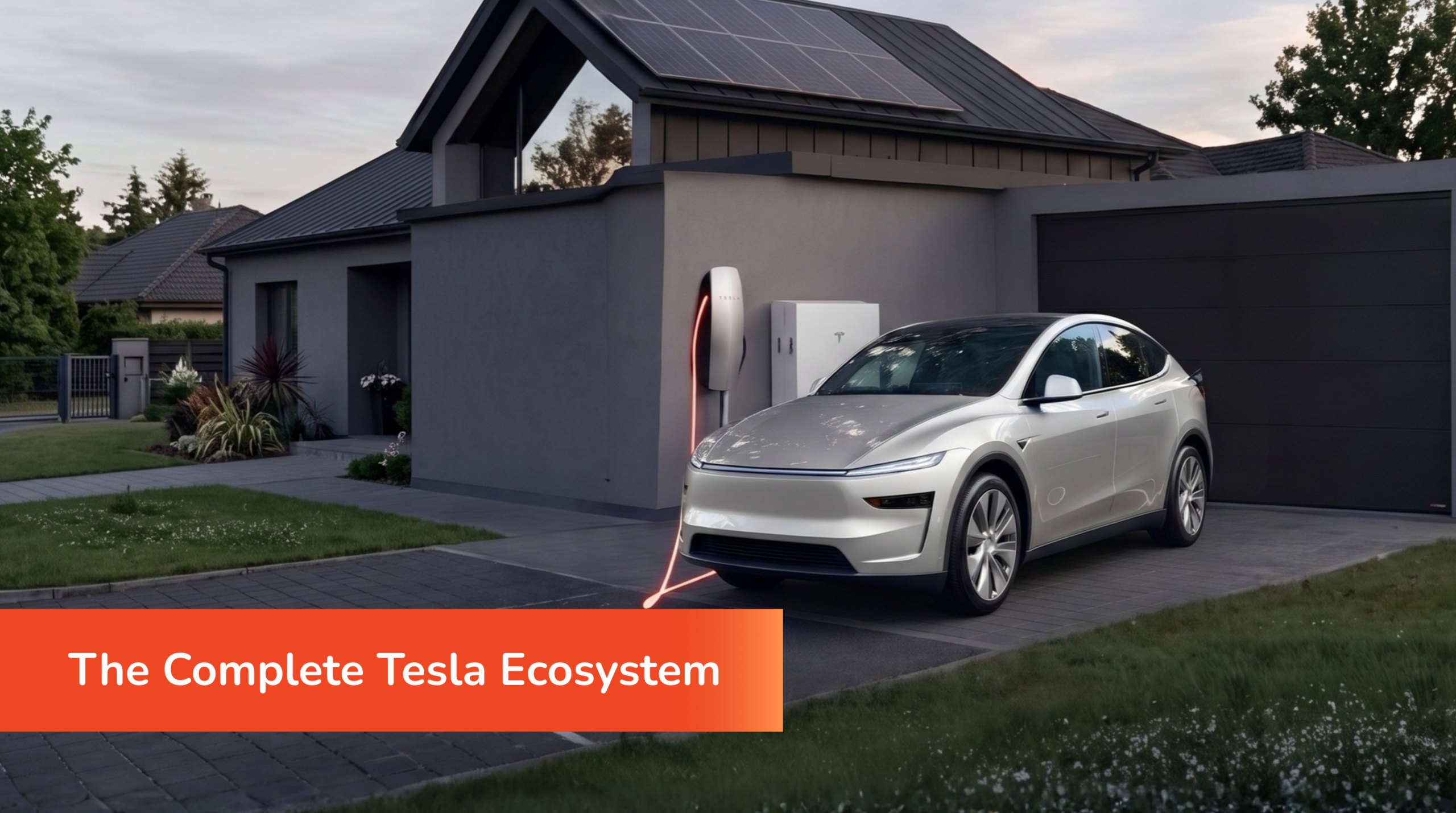
The Tesla ecosystem is rooftop solar, a Tesla Powerwall 3 battery, a Tesla Wall Connector and a Tesla car, all run from one Tesla app. Smart Energy Answers (SEA) in Castle Hill is the only retailer in NSW where you can test drive a Tesla and see the complete Tesla ecosystem working in one place.
If you’re a Hills District homeowner weighing up solar, a battery or an EV, this guide explains how each part works, how they connect, and what it could mean for your power and petrol bills. It also points you to where you can see the whole system in person in Sydney.
What is the Tesla ecosystem?
The Tesla ecosystem is four parts that work as one system: rooftop solar that generates energy, a Tesla Powerwall 3 that stores it, a Tesla Wall Connector that delivers it to your car, and a Tesla vehicle that uses it. You manage the energy side of the system from the Tesla app.
Rooftop solar
Panels on your roof turn sunshine into electricity that powers your home during the day. Whatever your home doesn’t use is surplus the rest of the system can put to work.
Tesla Powerwall 3
This is the home battery. It stores that surplus so you can use it later, and it has a solar inverter built in.
Tesla Wall Connector
This is the home charger. It connects your car to your home’s power and, when paired with a Powerwall, lets your car charge from your own solar.
Tesla car
The car is the part of the system that uses the energy. At SEA, that’s the six-seat Tesla Model Y L.
How does Powerwall 3 work with solar?
Tesla Powerwall 3 stores 13.5 kWh of usable energy from your solar, so you can use sunshine after the sun goes down. It has a built-in solar inverter that supports up to 20 kW of solar panels, and it can back up your home in an outage when installed with Tesla Backup Gateway 2.
If you’re researching a Tesla Powerwall 3 in Sydney, these are the figures to know:
- Storage: 13.5 kWh of usable energy
- Power: up to 11.04 kW of continuous power per unit
- Solar: built-in solar inverter, supporting up to 20 kW of solar panels
- Expansion: add up to three Powerwall 3 Expansion units, 13.5 kWh each
- Backup: backs up the home in an outage when installed with Tesla Backup Gateway 2
- Warranty: 10 years, managed in the Tesla app
You can read more on SEA’s Tesla Powerwall 3 page.
Can I charge my Tesla from my solar panels?
Yes. With a Tesla Powerwall and a paired Gen 3 Tesla Wall Connector, Tesla’s Charge on Solar feature uses excess solar to charge your EV. If there isn’t enough sun, it tops up from the grid or your battery. It needs a Tesla Powerwall, so it doesn’t work with other home batteries.
To use Tesla Charge on Solar in Australia, you need:
- A Powerwall 2 or 3
- A Gen 3 Wall Connector on firmware 26.34 or later
- The Tesla app, version 4.57.5 or later
- Your Powerwall in Self-Powered mode
Tesla explains the setup on its Charge on Solar support page. If you want to charge your Tesla with solar at home, this is the feature that makes it happen.
What does the Tesla Wall Connector do?
The Tesla Wall Connector is the home charger that links your solar and battery to your car. It charges at about 7 kW on single-phase power, or up to 11 kW on three-phase for a Tesla Model Y. It has a Type 2 connector with a 7.3 m cable and works with any recent EV sold in Australia.
One thing to plan for: since 2022, new Teslas in Australia no longer come with a home charging cable as standard. That means home charging is something you set up separately.
If you’re weighing up Tesla Wall Connector installation in Sydney, seeing the unit in person at SEA’s showroom is a good first step.
Where does the Tesla Model Y L fit in?
The Tesla Model Y L is the car that completes the system. It’s a six-seat version of the Model Y with a 2+2+2 layout and heated and ventilated second-row captain’s chairs. Its range is 681 km on the WLTP test cycle, and it can charge at home through the Tesla Wall Connector.
For a family in the Hills District, the extra row of seats is the headline. We cover the full specs, range and how to book in our guide to the Tesla Model Y L test drive in Castle Hill.
How much could the Tesla ecosystem save me?
The Tesla ecosystem can help you save on power and petrol by using your own sunshine instead of buying grid power and fuel. How much you save depends on how much energy you use, your electricity tariff and how much you drive, so the only reliable figure comes from a personalised assessment.
Here is the mechanism. Your solar panels generate during the day, your Powerwall 3 holds the surplus for later, and Charge on Solar sends excess solar to your car. Each step means less energy bought from the grid and less spent at the petrol station.
Whether it’s worth it comes down to your household’s own numbers. SEA can walk you through a personalised assessment based on your usage, your tariff and your driving.
Where can I see the Tesla ecosystem in Sydney?
You can see it at the Smart Energy Answers showroom, 2C Hudson Ave, Castle Hill NSW 2154. SEA is the only retailer in NSW where you can test drive a Tesla and see the complete Tesla ecosystem working in one place: rooftop solar, the Tesla Powerwall 3 demo unit, the Tesla Wall Connector and a Tesla Model Y L.
You can also take a free 30-minute Tesla Model Y L self-drive, booked through Tesla. Start on the Tesla Experience page to find out how.
Come and visit us and find out how you can get a free Tesla EV Charger. Conditions apply.
Frequently Asked Questions
Q: Do I need a Powerwall to charge my Tesla on solar?
A: Yes, for Tesla’s Charge on Solar feature. It needs a Tesla Powerwall 2 or 3 and a paired Gen 3 Tesla Wall Connector.Q: Can the Tesla Wall Connector charge other brands of EV?
A: Yes. The Tesla Wall Connector has a Type 2 connector and works with any recent EV sold in Australia.Q: Will a Powerwall 3 keep my home running in a blackout?
A: Yes. When it’s installed with Tesla Backup Gateway 2, Tesla Powerwall 3 backs up your home in an outage.Q: Can my Tesla power my home?
A: Not yet. In Australia, Tesla currently offers vehicle-to-load through an adapter, which powers appliances and devices. Vehicle-to-home and vehicle-to-grid haven’t been announced.Q: How much energy does a Powerwall 3 store?
A: A Tesla Powerwall 3 stores 13.5 kWh of usable energy. You can add up to three Powerwall 3 Expansion units, 13.5 kWh each.
Ready to see the Tesla ecosystem in Castle Hill?
If you’re a Hills District homeowner thinking about solar, a Tesla Powerwall 3 or an EV, the easiest next step is to see the whole system working. Visit SEA in Castle Hill, Sydney, take a free 30-minute Tesla Model Y L self-drive, and find out how the pieces fit your home.