
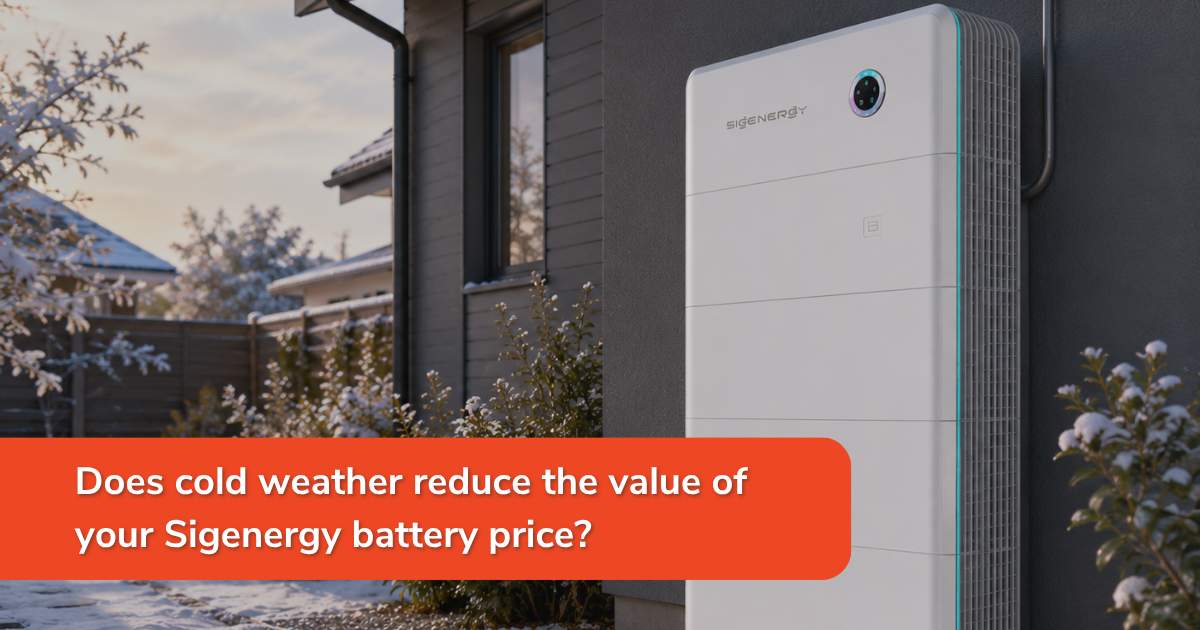
If you live in a part of Australia that gets genuinely cold winters, like Canberra, Melbourne, or the Blue Mountains in New South Wales, you have probably wondered whether the cold affects how well your solar battery performs. It is a fair question, and one we hear from customers fairly often at Smart Energy Answers. The short answer is that cold weather does have some effect on battery performance, but it is far less damaging than most people assume, especially with a well-engineered system like Sigenergy.
Let’s walk through what actually happens to battery storage in cold conditions, and whether it changes the value you get from your sigenergy battery price.
Most modern home batteries, including the Sigenergy SigenStor, use lithium iron phosphate chemistry, commonly known as LFP. This chemistry is well regarded for its thermal stability, handling both heat and cold better than older lithium chemistries found in some competing battery types.
In cold temperatures, a battery’s internal resistance increases slightly, which can temporarily reduce charging and discharging speed. However, this effect is not permanent and fully reverses once temperatures return to normal.
For most Australian homes, even in colder regions like Canberra or the Victorian Alps, temperatures rarely drop low enough to cause any meaningful performance loss across the system.
This is the question that really matters. When you are evaluating sigenergy battery price against what you actually get out of the system over its lifetime, cold weather performance is one part of that picture.
Here is the good news. Sigenergy batteries are designed to operate across a wide temperature range. Their LFP chemistry is naturally more stable in cold conditions than older battery technologies. The AI-driven energy management system inside the SigenStor also actively monitors conditions and adjusts charging and discharging behaviour to protect the battery when temperatures shift.
So while you might notice a minor reduction in output on the coldest days of the year in a place like Hobart or the Victorian Alps, it does not meaningfully change the overall return you get from your sigenergy battery price over the full lifespan of the system.
It is worth comparing how different batteries handle cold weather, particularly when looking at sigenergy battery price against tesla powerwall prices, since both are popular choices for Australian homeowners.
Tesla Powerwall uses NMC lithium chemistry, which is generally considered slightly more sensitive to temperature extremes than LFP. When customers ask us to compare price of sigenergy battery against the prices of tesla powerwall, we always encourage them to look beyond upfront cost and consider seasonal performance across the full year.
Sigenergy’s LFP chemistry, combined with its modular design and AI optimisation, delivers strong all-round performance whether it is a hot Perth summer or a cold Canberra winter.
At Smart Energy Answers, we are a nationally recognised solar and battery company with thousands of installations completed across Australia, including in colder climate zones. When we design a system for a customer in Melbourne, Canberra, or the Southern Highlands, we take local climate conditions into account from the very beginning.
Here are a few things we consider for cold climate battery installations:
The goal is always to make sure the price of sigenergy battery you pay translates into genuine, consistent value across every season of the year, not just the warm ones.
For the vast majority of Australian homes, cold weather causes only minor seasonal variation that does not change the fundamental case for investing in battery storage. When comparing tesla powerwall prices against sigenergy battery price side by side, what truly tips the balance for most customers is long-term reliability, smart energy management, scalability, and quality after-sales support.
At Smart Energy Answers, we have been recognised as one of Australia’s top solar retailers multiple years running, earning awards from ProductReview, EUPD Research, and Sunwiz. We stand behind every system we install and support you well after installation. Cold weather is never a reason to wait. Get a free quote today.
No, cold weather does not cause permanent damage. LFP chemistry recovers fully once temperatures return to the normal operating range.
The price of sigenergy battery is competitive and often offers strong value when you factor in its five-in-one integration, scalability, and built-in AI energy management compared to tesla powerwall prices.
Installing it in a sheltered spot such as an internal wall or garage helps buffer the battery from temperature extremes and maintains consistent year-round performance.
Yes. Solar panels generate electricity from sunlight, not heat. Cold, clear winter days can actually produce solid solar generation, particularly when paired with high-efficiency panels like Aiko solar panels.