
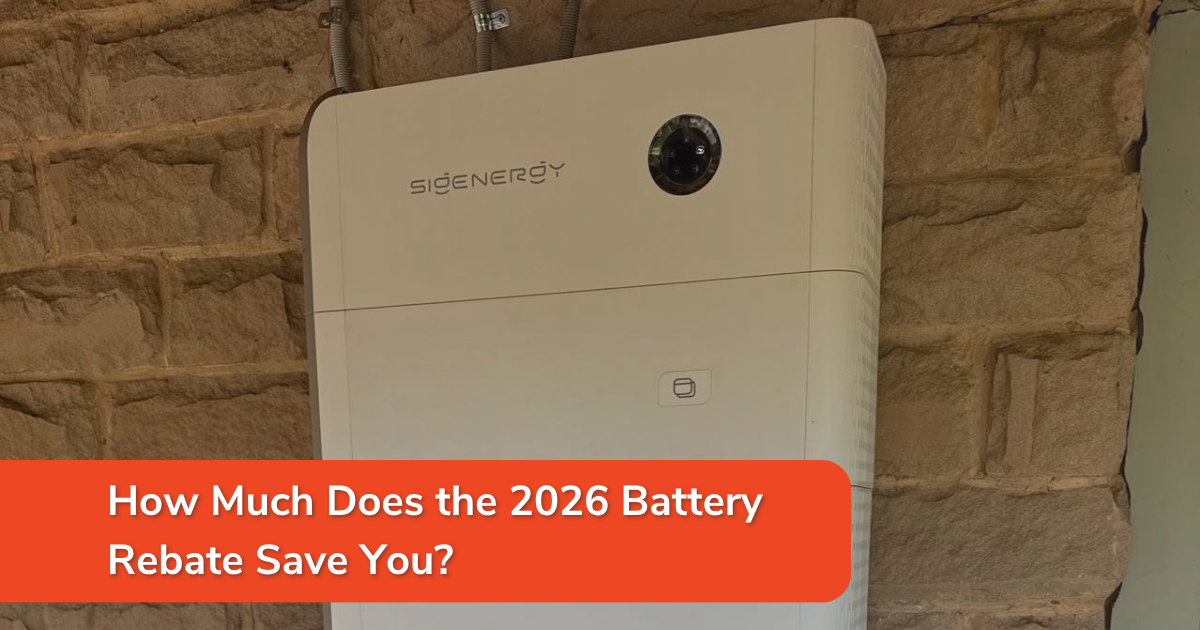
With energy prices still top of mind for many Australians, the federal Cheaper Home Batteries Program has quickly become a major topic of interest across the energy market.
Most customers are not looking for policy detail alone.
They want clear answers on how the programme works, what they may save, whether they are eligible, and whether they should install before or after 1 May 2026.
How does the rebate actually work?
How much can I save?
Am I eligible?
And should I install now or wait?
This guide breaks it all down in plain English so you can make a confident decision.
The Australian Government’s Cheaper Home Batteries Program is designed to reduce the upfront cost of eligible small-scale battery systems installed alongside new or existing rooftop solar.
The programme is delivered through the Small-scale Renewable Energy Scheme, or SRES, using STCs.
In many cases, the benefit is passed on through the installer or retailer as an upfront discount, although the way it appears on quotes or invoices can vary.
The programme has been available for eligible battery systems installed on or after 1 July 2025.
The amount you could save in 2026 depends on several factors, including:
While exact figures vary, eligible customers may receive a meaningful reduction in upfront battery cost, particularly where the system is appropriately sized and installed in accordance with programme requirements.
For example, a 10kWh battery may attract support that suits an average household profile.
A 20kWh battery may attract a larger total discount than a smaller system, but that does not automatically mean better value.
Under the federal programme, batteries from 5kWh to 100kWh nominal capacity may be eligible, but STCs are only available on the first 50kWh of usable capacity.
From 1 May 2026, support is also tapered by capacity bands, which makes correct sizing even more important.
The key is not just the rebate amount, but how well the system matches your household usage.
This is one of the most common questions, and the answer depends on how much solar you produce, how much electricity you use after sunset, and whether the battery is appropriately matched to the site.
Important: Bigger is not always better.
Oversizing a battery without matching it to the site’s load profile, solar production, and inverter setup can reduce value.
Eligibility depends on whether the battery system meets the federal programme requirements, including:
This federal programme is not limited to residential homes.
It also applies to eligible installations for businesses and community organisations.
Because requirements can change, eligibility should always be confirmed at the time of quoting and installation.
One of the biggest reasons this topic is gaining attention is the confirmed change to the programme from 1 May 2026.
From that date:
This creates a common timing decision for customers:
For many households, installing earlier can provide both immediate savings and earlier bill reductions, rather than waiting for uncertain future changes.
There’s no universal answer, but here’s how to think about it.
In many cases, delaying installation means delaying the bill and self-consumption benefits of the battery.
Whether waiting makes sense depends on the site, the proposed battery size, and how the 1 May 2026 settings affect the system.
To get the most from the federal battery programme:
The goal isn’t just to get a rebate.
It’s to get a system that performs well long term.
The federal Cheaper Home Batteries Program remains a major opportunity in 2026 for eligible Australian households, businesses, and community organisations to reduce the upfront cost of battery storage and improve how they use solar energy.
But the real value doesn’t come from the rebate alone.
It comes from choosing the right system, at the right time, for your home.
With changes commencing from 1 May 2026, understanding how the programme works now can help customers make a better timing and sizing decision.
The rebate is only one part of the equation.
Overall value depends on choosing a battery size and system design that suits the property, energy usage, and installation timing.