
Australia’s Cheaper Home Batteries rebate has driven one of the fastest adoptions of solar batteries in the world, outpacing the expectations of policymakers.
This week, the Smart Energy Council, or SEC, held an urgent seminar outlining the current reality: funding is being consumed at an unprecedented rate, battery sizes have ballooned, and without intervention, the entire $2.3 billion scheme could exhaust months, or even years, ahead of schedule.
At Smart Energy Answers, we support reforms that protect consumers, ensure long-term industry stability, and secure continued access to quality storage solutions like the Tesla Powerwall 3, Sigenergy batteries, and ESY Sunhome systems, all available through our curated SEA Smart Batteries range.
Below is a clear breakdown of what the new information means for Australian households.
The Cheaper Home Batteries rebate aims to make energy storage more accessible by offering a discount of around 30% off eligible systems through the Small-scale Renewable Energy Scheme, or SRES.
Recent data shows that households are choosing larger batteries than before, with the average system installed since October sitting at around 28kWh.
At the same time, a big share of the rebate budget is being used on large batteries of 50kWh and above in larger homes and commercial property settings.
The Smart Energy Council, a key industry group, says that without sensible updates, the rebate risks a boom-bust cycle that could hurt both consumers and the battery industry.
SEC CEO John Grimes has called for tweaks to system sizing and rebate settings to ensure the programme remains sustainable and continues to deliver value.
From day one, the federal solar battery rebate was designed to taper gradually, following this original glide path before administration and trading costs:
Even in 2030, a typical 20kWh battery would still receive more than $3,500 in support.
But right now, that same system attracts more than $7,000, almost double what was planned.
The problem isn’t that the rebate is decreasing.
The problem is that the scheme expected a controlled descent, and instead, demand has gone vertical.
This is where the SEC’s warning becomes stark.
At around $300 to $350 per kWh, that frequently means rebates of $8,400 or more per installation.
Official figures show $850 million to $900 million already paid out.
But once systems already sold and deposits taken are included, total committed spend is closer to just under $2 billion.
That leaves roughly $400 million to $600 million uncommitted, which means only weeks of funding at current burn rates, not months.
This is why the Federal Government is alarmed.
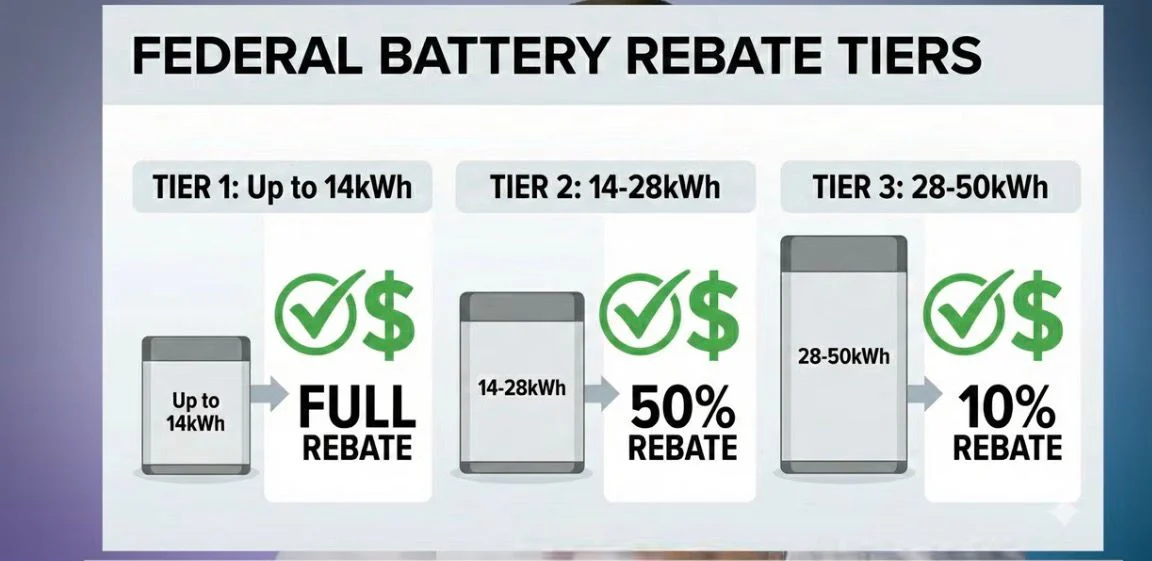
The Smart Energy Council presented a tiered rebate structure as the fairest and most stabilising solution.
This model:
It targets the extremes, from the $4,000 low-end, low-quality installations to the $20,000-plus oversized rebate harvesters, and creates a more balanced landscape.
The question is whether the government will allocate another approximately $500 million to extend the scheme into late 2026.
The SEC was crystal clear: hard caps or abrupt cuts would be catastrophic.
They risk:
The SEC is urging the government to avoid a sudden guillotine.
However, they also admitted that warnings do not control the Federal Government.
This is no longer just an energy decision.
It is a Federal Government budget-protection decision.
The government recently cut a $300 household energy bill rebate that would have supported:
If that programme could not survive the budget process, the Federal Government may not protect a battery rebate helping a much smaller group while burning $350 million per month.
The maths is sobering.
A three-month taper would add approximately $700 million to $1 billion more in unplanned budget spend.
The Federal Government may simply not accept that.
Despite the rebate crisis, one truth remains.
Australia cannot meet its renewable energy goals without batteries.
Home batteries are:
Killing the scheme outright would be:
This is the difficult crossroads Australia now faces.
If you are considering a battery, acting sooner rather than later is the safest option while the rebate is still high and before any sudden policy change.
Explore SEA’s recommended systems:
Tesla Powerwall 3 Solar Storage