
Three Hours of Free Power a Day: What It Means for Solar + Battery Owners in Australia

Three Hours of Free Power a Day: What It Means for Solar + Battery Owners in Australia Smart Energy Answers June 3, 2026 Australia’s energy landscape is about to experience a major shift. Starting July 2025, millions of households will gain access to three hours of free power every day, under a new initiative introduced by the federal government and supported by leading energy retailers. It’s a move that’s already being described as one of the biggest shake-ups in the Australian energy market — and for homeowners with solar and battery systems, it could mean free nightly energy, lower bills, and faster returns on investment. What the “Three Hours of Free Power” Scheme Means Under the new scheme, electricity retailers will offer Australian households three hours of free energy use per day, typically during off-peak daylight hours when renewable generation is highest. According to ABC News and The Guardian, the goal is simple, make better use of Australia’s abundant daytime solar generation while reducing grid pressure during peak demand at night. This new program is not just a win for energy retailers. It’s a massive opportunity for homeowners with batteries. By pairing your solar panels with an intelligent battery system, you can charge your battery for free during those three hours, then use that stored power in the evening when grid prices spike. In other words: free energy in, zero-cost power out. Why This Matters for Homeowners with Batteries For those who already own a Tesla Powerwall 3 or Sigenergy battery, this initiative could drastically improve your savings. If you’re considering an upgrade or new installation, the timing couldn’t be better. The solar battery rebate already helps lower upfront costs, and this new federal policy adds another layer of value, free daily charging that can offset hundreds of dollars in annual energy bills. Meanwhile, modern batteries like the ESY Sunhome and Sigenergy models are designed for intelligent charging, allowing you to automatically schedule energy storage during those no-cost hours. Real-World Impact: Turning Policy into Savings Let’s take a typical Sydney household with a 13.5 kWh Tesla Powerwall 3. If that system is fully charged during the free window and used during evening hours, it could save up to $700–$900 annually, depending on local energy rates. For those in NSW or Victoria, where tariffs can exceed 35 ¢ / kWh during peak demand, these savings quickly add up, especially when paired with an energy-efficient home setup and smart solar management tools. Choosing the Right Battery to Maximise the Benefit Not all batteries are created equal, and to take full advantage of the free power scheme, you’ll want a system that can charge quickly, store efficiently, and integrate seamlessly with your solar setup. Sigenergy batteries are engineered for smart, flexible energy control, offering outstanding capacity and advanced AI-based management. The ESY Sunhome provides robust performance at a competitive Sigenergy battery price, making it ideal for households focused on long-term ROI. And of course, the Tesla Powerwall 3 continues to set the benchmark for performance, with intelligent energy dispatch and grid-ready compatibility. To unlock even greater benefits, homeowners can pair these batteries with Amber’s Virtual Power Plant (VPP). By joining the Amber VPP, your battery can automatically trade energy during high-demand periods, earning credits or payments while supporting grid stability. When combined with the new three hours of free power policy, this creates a powerful cycle of free charging, smart trading, and round-the-clock savings — turning your home into a truly intelligent energy hub. What Homeowners Should Do Now Assess Your Energy Usage: Identify your peak energy times and total daily demand. Upgrade to a Smart Battery System: Look for batteries with advanced charging controls to make the most of the free power period. Check Your Eligibility: Rebates and incentives are available for eligible households. Our team at Smart Energy Answers can help guide you through the solar battery rebate process. Plan Your System Now: With the Tesla Powerwall 3 price and Sigenergy battery price becoming more competitive, now’s the perfect moment to install before demand surges in mid-2025. The Bigger Picture: A Smarter, Greener Australia This three-hour-free-power initiative isn’t just about cost savings. It’s a strategic step toward a cleaner, more efficient energy grid. By encouraging households to store and use renewable energy during off-peak hours, Australia moves closer to achieving its national net-zero goals while empowering everyday Australians to take control of their energy future. At Smart Energy Answers, we’re proud to be part of this transition, helping homeowners integrate technologies like Tesla Powerwall 3, Sigenergy batteries, and ESY Sunhome into systems that deliver real independence, savings, and sustainability. Ready to Make the Most of Australia’s Free-Power Future? Explore your options with our Smart Battery Solutions today, and turn your solar system into a 24/7 energy powerhouse.
Sigenergy vs ESY Batteries: 2026 Rebate Comparison & What It Means for You
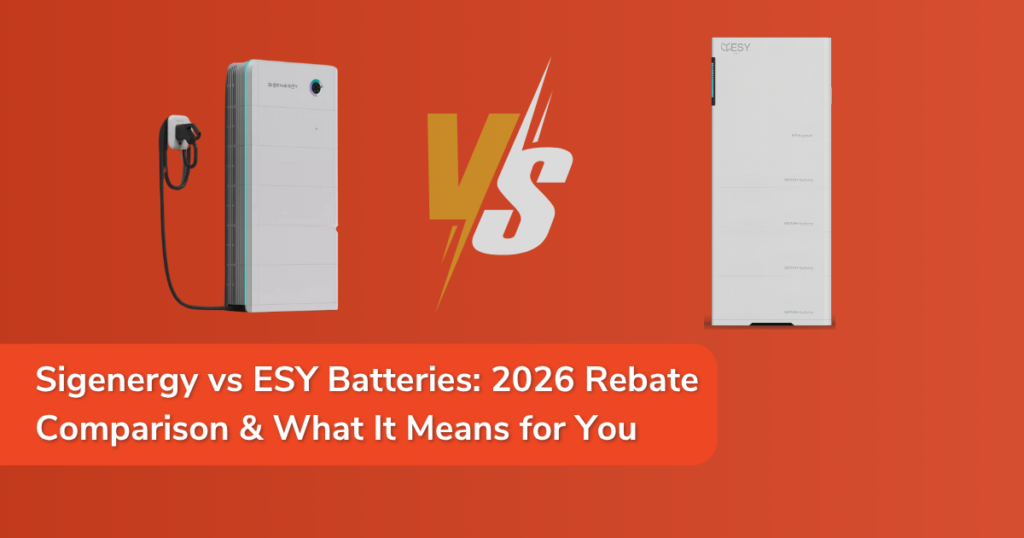
Sigenergy vs ESY Batteries: 2026 Rebate Comparison & What It Means for You Smart Energy Answers June 3, 2026 As Australia heads into 2026, home battery systems are at a major turning point. With rebate changes on the horizon, rapidly evolving technology, and more homeowners comparing value vs features, choosing the right system has never been more important. In this guide, we’ll compare two of the most talked-about systems, the Sigenergy Battery and the ESY Sunhome Battery, and explore how the 2026 rebate structure could affect your decision. Why This Comparison Matters in 2026 Battery prices have dropped significantly, but federal and state solar battery rebates will gradually reduce after January 2026. Choosing the right battery system now can lock in savings before the rebate cut-off. The best decision balances upfront cost, long-term performance, scalability, and warranty support. If you’re exploring solar batteries in Australia, names like Sigenergy, ESY, and Tesla Powerwall 3 stand out for their reliability, smart features, and eligibility under current rebate programs. 2026 Solar & Battery Rebate Updates According to recent policy updates, the federal solar and battery rebates will begin to step down from 1 January 2026. For solar panels via STCs, the value of credits will reduce annually. For batteries, the upfront rebate value based on energy capacity will also decrease. This means that households planning an upgrade in 2026 can still access substantial support, but the earlier you act, the higher your rebate return. You can learn more about SEA’s installation process and rebate support at Smart Energy Answers. Sigenergy Battery: Smart, Scalable & Future-Ready The Sigenergy Battery is redefining home and business storage systems in Australia. Designed for intelligent, modular energy management, it’s one of the best solar batteries in Australia for flexibility and control. Key Advantages Modular, scalable design from 5 kWh to 60 kWh+ Built-in EV-charger compatibility and full-home backup capabilities Smart thermal sensors and fire protection for safe operation in extreme weather Seamless integration with Virtual Power Plant (VPP) programs Long warranties backed by a global innovation leader While the Sigenergy battery price is slightly higher than some competitors, its superior features and longevity make it a future-proof investment for both homes and businesses. ESY Sunhome Battery: Efficient, Reliable & Value-Focused For homeowners prioritising affordability and solid performance, the ESY Sunhome Battery delivers impressive value. Highlights Competitive upfront pricing Compact, efficient design ideal for smaller homes Simple interface and straightforward installation Eligible for the federal solar battery rebate Reliable performance backed by industry-standard warranties If your goal is to lower upfront costs without compromising reliability, ESY offers a cost-effective entry point into home energy storage. Sigenergy vs ESY: 2026 Comparison Table Feature Sigenergy Battery ESY Sunhome Battery Upfront Cost 10 kWh ~$14,000–$15,500 ~$9,000–$10,500 Rebate Eligibility Federal + VPP options Federal rebate Design Modular, scalable, high-tech Compact, efficient EV-Charger Integration Yes No Full-Home Backup Yes Partial Ideal For High-usage or commercial sites Budget-conscious homes Typical Rebate Amounts 2026 Module Approximate Rebate 20 kWh ~$6,000 30 kWh ~$9,000 40 kWh ~$12,000 50 kWh ~$15,000 Don’t Forget Your Solar Panels Pairing your battery with the right panels maximises your savings. Aiko Solar Panels offer record-breaking efficiency and work seamlessly with both Sigenergy and ESY systems. For those exploring hybrid or premium setups, SEA also installs the Tesla Powerwall 3, another top-tier option for whole-home backup, long lifespan, and easy energy monitoring. Why Rebate Timing Matters Installing your battery in 2025 or early 2026 can help you: Secure the highest rebate tier before step-down Maximise your system ROI over 10+ years Avoid potential price increases on components as demand spikes SEA Case Study: Real Results For example, one of Smart Energy Answers’ retail clients reduced their annual energy spend by 28% after implementing a centralised battery system across multiple NSW locations. The result? Better performance tracking, lower grid reliance, and a faster payback period, proof that the right technology mix pays off. Final Thoughts Both the Sigenergy battery and the ESY Sunhome battery represent excellent pathways to energy independence in 2026. Sigenergy is ideal for those seeking performance, scalability, and future-readiness. ESY suits homeowners prioritising simplicity and affordability. If you’re exploring solar battery rebates or want help comparing systems before incentives decrease, now’s the time to act. Contact Smart Energy Answers today for a tailored quote and expert advice.
Battery Storage for Businesses: Is It Worth the Investment?
Battery Storage for Businesses: Is It Worth the Investment? Smart Energy Answers June 3, 2026 As energy costs continue to rise and businesses seek greater energy independence, battery storage has become an increasingly viable solution. Whether integrated with solar power or used independently, commercial battery storage systems can help businesses reduce electricity costs, enhance energy resilience, generate revenue by selling stored energy, and achieve sustainability goals. But is it worth the investment? Let’s explore the benefits, costs, and ideal use cases to help you determine if battery storage is right for your business. What Is Commercial Battery Storage? Battery storage systems allow businesses to store excess energy, either from on-site solar panels or the grid, for use during peak hours or power outages. Additionally, businesses can sell stored energy back to the grid, turning battery storage into a revenue-generating asset while also strategically managing energy consumption to significantly cut electricity expenses and improve operational efficiency. Key Benefits of Battery Storage for Businesses Lower Energy Costs & Revenue Generation Store cheap or excess solar energy and use it during peak demand hours, when electricity rates are highest. Reduce reliance on expensive grid power, especially in areas with high demand charges. Participate in energy arbitrage, storing electricity when prices are low and using it when prices are high. Sell stored energy back to the grid through Virtual Power Plant (VPP) programs, earning revenue while contributing to grid stability. Energy Resilience & Backup Power Protect operations from blackouts and power disruptions that could cause downtime. Essential for businesses with mission-critical operations, such as manufacturing plants, data centres, and hospitals. Maintain smooth operations in industries reliant on continuous power supply. Sustainability & ESG Compliance Reduces carbon footprint by maximising clean energy use. Helps businesses meet ESG, Environmental, Social, and Governance, goals and qualify for green incentives. Enhances corporate reputation and compliance with government sustainability policies. Supports renewable energy adoption while turning energy storage into a revenue stream. Cost & ROI: Is It Financially Viable? Upfront Costs vs Long-Term Savings Battery storage costs vary based on capacity, brand, and system integration. ROI depends on energy rates, demand charges, and how the business uses energy. Many businesses achieve payback within 5 to 8 years, especially with available government incentives. Revenue generation from stored energy sales through VPPs can further accelerate ROI. Government Incentives & Tax Benefits Businesses can leverage federal and state rebates to lower upfront costs. Additional benefits include tax write-offs and grants for businesses investing in renewable energy solutions. Ideal Industries for Battery Storage Adoption Manufacturing & Warehousing: Handles high energy use efficiently, reducing demand charges while selling stored energy for added revenue. Retail & Hospitality: Lowers operational costs while ensuring backup power and participating in energy trading programs. Agriculture: Stabilises energy supply for irrigation, refrigeration, and processing, with potential earnings from excess solar storage. Commercial Offices: Supports energy efficiency, sustainability branding, and revenue generation through stored energy sales. Best Recommended Batteries There are a wide variety of batteries to choose from. Here are a few options to make that decision easier for you: Tesla Powerwall 3 Higher power output compared to previous models. Integrated solar inverter for seamless system management. Supports whole-building backup capabilities. Sungrow SBR Battery High-performance lithium iron phosphate (LFP) battery for safety and longevity. Modular design, allowing businesses to expand storage over time. Works efficiently with both on-grid and off-grid systems. Sigenergy Battery Storage Smart energy management system for enhanced efficiency. Fast charging and discharging capabilities. Ideal for businesses looking for flexible and scalable solutions. ESY Battery Advanced lithium-ion technology for improved performance and durability. Modular and scalable design to adapt to business energy needs. High-efficiency energy conversion, maximising stored energy use and grid sales potential. How to Choose the Right Battery Storage System Capacity & Scalability: Ensure the system meets your current and future energy demands. Battery Chemistry: Choose between lithium-ion, higher efficiency and longer lifespan, and lead-acid, lower upfront cost. Warranty & Lifespan: Look for long-term reliability and manufacturer support. Integration with Solar: Maximise benefits when paired with solar PV systems. Potential for Revenue Generation: Assess whether the system supports VPP participation to sell stored energy back to the grid. Should Your Business Invest in Battery Storage? Battery storage offers significant cost savings, energy security, and sustainability benefits. If your business faces high electricity bills, demand charges, or grid reliability issues, investing in battery storage could be a smart move. Additionally, participating in a VPP program allows businesses to generate revenue from stored solar energy, making the investment even more financially attractive. Want to explore battery storage for your business? Contact Smart Energy Answers for a tailored assessment.