
8 Key Benefits of Using a Virtual Power Plant with Your Home Battery Storage
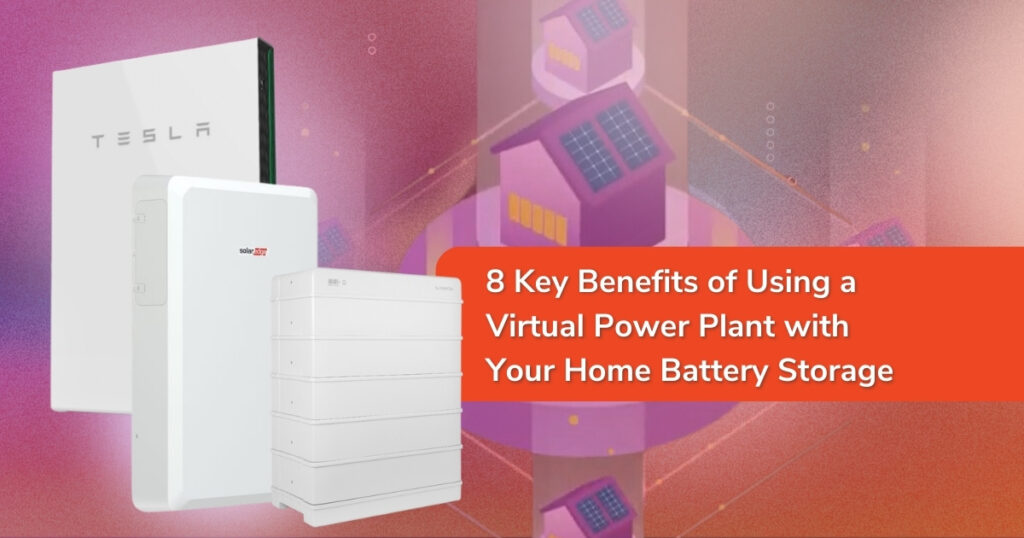
8 Key Benefits of Using a Virtual Power Plant with Your Home Battery Storage Smart Energy Answers June 7, 2024 As a homeowner, you are constantly looking for ways to reduce costs and improve efficiency in your household. With electricity prices expected to rise significantly year on year, now is the perfect time to consider integrating your home with a battery storage system and a Virtual Power Plant, or VPP. Transforming your house with a smart home upgrade using solar panels, home battery storage, and a VPP can be a game-changer. It can help you save money while speeding up the payback period of your system. A smart home upgrade also provides numerous other benefits. Here are eight key advantages of using a VPP with your home battery storage. 1. Earn Money From Your Electricity Retailer One of the most attractive benefits of using a VPP is the potential to earn money. By joining a VPP, your home battery storage system can contribute excess energy to the grid during peak demand periods. Electricity retailers pay for this energy, providing you with a new revenue stream. Essentially, you become a small-scale energy provider, selling surplus electricity from your solar panels and battery back to the grid. Reducing or even eliminating electricity bills is one thing, but is it possible to earn credits from your retailer and cash those credits out? Welcome to the next level of smart energy management. Take Matt’s experience as an example. He earned nearly $1,000 in a single day with Amber Electric’s VPP. Similarly, at Smart Energy Answers, our 99 kW system at our headquarters ensures that we no longer receive electricity bills. Instead, we receive cheques. 2. Reduce Your Electricity Bills With a VPP, your home battery storage system can optimise the way you use your energy. You can significantly reduce your electricity bills by strategically managing when you draw electricity from the grid and when you use stored energy. During times of peak electricity prices, the VPP can draw energy from your home battery rather than the grid, reducing the amount of expensive electricity you purchase. Electricity prices often vary throughout the day, with higher rates during peak demand periods. A VPP can shift your energy consumption to times when electricity prices are lower. For example, it can charge your battery during off-peak hours when electricity is cheaper and use this stored energy during peak hours, effectively lowering your overall energy costs. By leveraging these programmes, a VPP ensures you make the most of your stored energy and minimise your dependence on expensive grid electricity. Over time, these savings can add up to a substantial amount. Example Energy Usage Scenario Scenario Energy Source Battery Action Morning – Low Demand Solar + Grid Charge battery Noon – Mid Demand Solar Charge battery from solar and export excess energy Night – High Demand Grid + Battery Use battery 3. Increased Energy Independence A VPP reduces your reliance on the traditional power grid. By integrating your home battery storage system with a VPP, you can generate, store, and manage your own energy, making you less dependent on external electricity providers. This increased energy independence is especially beneficial during power outages or grid instability. It helps ensure your home remains powered even when the grid goes down. It also means you are less affected by fluctuations in energy prices. 4. Environmental Benefits Participating in a VPP contributes to a greener environment. By storing excess energy generated from renewable sources, such as solar panels, and feeding it back into the grid, you help reduce reliance on fossil fuels. VPPs effectively integrate renewable energy into the grid. This not only decreases your carbon footprint but also supports the transition to a more sustainable energy system. 5. Enhanced Grid Stability VPPs aggregate power from many home battery storage systems to provide a reliable source of energy to the grid. This helps stabilise the grid, especially during periods of high demand or unexpected power plant outages. By participating in a VPP, you play your role in enhancing overall grid stability and reliability. A notable example of this occurred in early May. According to the Australian Energy Market Operator, or AEMO, several major generation units in New South Wales went offline while transmission line maintenance was underway, leading to high demand for energy. During this critical period, VPPs played an important role in stabilising the grid. By drawing power from the distributed network of home battery storage systems, VPPs were able to supply much-needed electricity and reduce the impact of a power shortage. In fact, around 2,900 VPP participants in New South Wales collectively earned a staggering $525,424 in a single day because of their solar exports through their VPP. This win-win situation showcases the advantages of integrating home battery storage systems with VPPs. Homeowners earned income, enhanced their individual energy independence, and supported overall grid stability. 6. Access to Real-Time Energy Data Many VPP platforms provide homeowners with access to real-time data about their energy usage and production. This information can help you make informed decisions about your energy consumption, identify opportunities for further savings, and gain a better understanding of your household’s energy needs. This real-time data can also offer better bill transparency, allowing you to track and understand your energy billing charges more accurately. Additionally, it can support preventive maintenance by continuously monitoring system performance and identifying potential issues. This helps ensure your energy system operates efficiently and reliably. 7. Optimised Battery Usage A VPP can optimise the usage of your home battery storage system. Advanced AI-driven algorithms manage the charging and discharging of your battery to maximise efficiency and lifespan. This means you get the most out of your battery storage investment. The VPP helps ensure your battery performs at an optimal level for a longer period. 8. Support for Renewable Energy Integration The integration of your home battery storage system with a VPP supports the broader adoption of renewable energy sources. VPPs help manage the intermittent nature of
Scaled-Back Plans to Charge Solar Households for Exporting Energy
Scaled-Back Plans to Charge Solar Households for Exporting Energy Smart Energy Answers June 4, 2026 Securing Solar Futures: Revised Approach to Charging Solar Households for Energy Export Controversial plans by the Australian Energy Market Commission, or AEMC, to charge households using rooftop solar panel systems for exporting energy back into the power grid have been scaled back in order to protect the investments of current and future solar system owners. Plans to reduce the impact of the proposed reforms on solar users came in an announcement from the commission in August. The AEMC’s initial plans were outlined in a draft declaration back in March, with the goal of determining how to integrate more small-scale solar and other new energy technologies, such as batteries, into the electricity grid. In the draft declaration, AEMC Chief Executive Ben Barr claimed, “We can decarbonise the electricity sector faster and cheaper if we connect more small solar customers and make it worthwhile for them to install batteries. But to do that we need to make some changes to the power system.” The draft determination addressed the issue of traffic jams on the network, when energy was being exported back onto the grid during busy times. It included a package of reforms designed to change distribution networks’ existing incentives to help households send power back into the grid. This would allow networks to offer two-way pricing, rewarding solar households for sending power back to the grid when it was needed and charging for sending power back when the system was too busy. Solar Reforms Finalised In a statement released in August, the AEMC released the finalised details of the reforms. According to the statement, “the reforms will put tough new obligations on power network companies to make their networks smarter.” “They will now be accountable for getting their businesses solar- and battery-friendly so everyone benefits. A key part of the changes is removing the companies’ ability to put blanket bans on customers sending solar energy back to the grid.” The reform package means that power networks can offer solar households a range of options, including a free basic service, in order to encourage users to limit solar waste and save money while benefiting the grid. AEMC Chair Anna Collyer claimed, “These new measures to drive smart solar are fundamental to enabling a modern electricity grid that delivers out to 2030 and beyond.” “They represent a profound change to the way poles and wires businesses must think about how they manage their network and turn the current one-way street delivering power to people’s homes into a two-way superhighway where energy flows in both directions.” “Power network companies will need to deliver services to support solar, and they’ll be judged on their performance on how much solar exports they allow into the grid.” The reforms acknowledge the fact that Australia has the fastest uptake rate of household solar power systems in the world. They also address concerns from users requesting more certainty on what the changes will mean for current and future solar investments. “We’ve listened to the feedback we have received and have tightened protections for consumers to increase certainty,” said AEMC Chief Executive Benn Barr. “This means networks will have to offer a free basic service alongside any paid solar export plans, so people won’t have to pay if they don’t want to.” Solar Batteries Are Becoming the New Normal While the AEMC scaling back the severity of the reforms protects the interests of current solar users, the fact remains that the Australian renewable energy sector has progressed in leaps and bounds in recent years. While simple, small-scale solar panel systems were sufficient for the needs of many households through the early years of Australia’s solar power revolution, it’s clear that going forward, fully integrated solar power systems equipped with batteries will be a much more profitable option. Any residential or commercial users considering installing a solar system should do their research and consider having a battery installed at the same time. This can help pay off the investment as quickly as possible and maximise profits. Virtual Power Plants Are the Future Virtual power plants function as a collective of separate solar batteries that are networked together in a sophisticated system. This allows them to function individually while also working together to store energy and efficiently trade or sell it to the grid. A virtual power plant, or VPP, is software that connects a collection of batteries localised in a community and allows them to function as a local virtual power plant. Individual solar households can band together to pool their power generation and storage capacities. This can benefit each other and reduce reliance on purchasing expensive traditionally generated power from the grid. The Smart Community Program VPP Smart Energy Answers has launched The Smart Community Program, a virtual power plant designed to help empower solar households. The programme turns individual systems into potent energy generators, reducing household costs while adding extra credit to users’ power bills. During times of high power demand, the energy provider can access the excess storage capacity of the individual batteries within the VPP and feed the power back into the network. Moving to virtual power plants allows individual households and their communities to benefit by cutting costs, utilising locally sourced power, avoiding power outages altogether, and enjoying high feed-in tariffs of up to 45c. Interested in joining the Smart Community Program or want more information? Call us on 1300 948 619.