
Solar Batteries Decoded : Top FAQs & Insights for Savvy Consumers
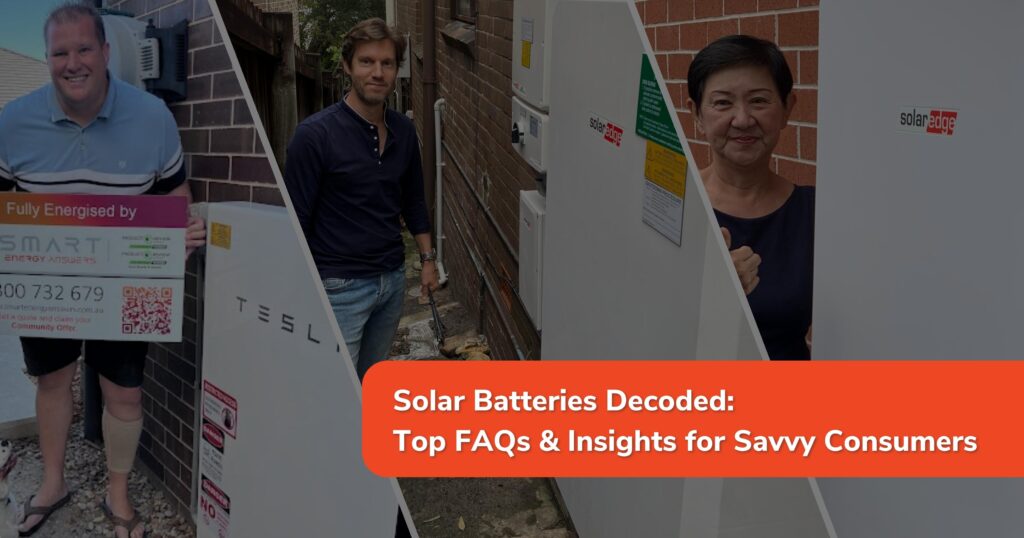
Solar Batteries Decoded : Top FAQs & Insights for Savvy Consumers Smart Energy Answers September 6, 2023 Understanding Solar Batteries In an era where sustainability meets innovation, the demand for solar with batteries has increased significantly. More families in Australia want to use cleaner energy and take greater control of their power, which is why solar batteries are becoming increasingly popular. At Smart Energy Answers, we are excited to explain solar batteries in this blog. We are also here to share some of our customers’ top questions to help you make informed decisions about your energy future. Solar Battery FAQs FAQ 1: How Can Solar Batteries Save Me Money on Electricity Bills? Solar batteries offer potential savings on electricity bills by capturing surplus energy produced by your solar panels during sunny periods. This stored energy becomes available during less sunny hours, including nights, rainy days, and cloudy weather. By reducing reliance on grid power during peak periods, you can cut down on costly electricity expenses and move closer to energy independence. With a properly sized solar and battery system, some customers can aim for $0 electricity bills. FAQ 2: Do Solar Batteries Qualify for Incentives or Rebates in Australia? Yes, incentives are available in different states across Australia. In addition, some of our partners also offer special Virtual Power Plant, or VPP, rebates for specific networks and territories. FAQ 3: What Size Solar Battery Do I Need for My Home? The size of the solar battery you need for your home in Australia depends on several factors, including the following: Energy consumption: Understand your household’s daily energy consumption. Review your past electricity bills to see how much energy you use on average. A larger battery may be suitable if you have higher energy needs. Solar panel system size: The capacity of your solar panel system matters. A larger system can produce more surplus energy, which can then be stored in the battery. Usage patterns: Consider when you use the most electricity. If you typically consume more energy in the evening, a larger battery can help you rely less on grid power during those times. Grid connectivity: If you are aiming for energy independence and want to reduce grid reliance, a larger battery may be beneficial. Smaller batteries are often used for backup power during outages. Budget: Larger batteries tend to be more expensive. Balance your energy needs with your budget to find the right size that offers the best value. Future expansion: If you plan to expand your household or increase energy usage in the future, factor in potential changes when selecting the battery size. It is recommended to consult with a solar energy expert to determine the optimal battery size that aligns with your household’s needs and usage patterns. FAQ 4: What Factors Should I Consider When Selecting a Solar Battery for My Home? Capacity: Choose a battery with sufficient capacity to meet your energy needs. Efficiency: Look at how efficiently the battery stores and releases energy. Higher-efficiency batteries can save more of the energy generated by your solar panels. Installation and compatibility: Ensure the battery is compatible with your existing solar panel system and inverter. Consider installation requirements, space, and placement options. Scalability: If you plan to expand your solar system in the future, choose a battery that can be easily integrated with additional panels. Warranty and support: Research the manufacturer’s reputation, warranty terms, and customer support. A reliable warranty can provide peace of mind. Cost and value: Balance the upfront cost of the battery with the potential savings it can offer over its lifetime. Consider any available government incentives or rebates. Safety: Battery safety features are crucial. Look for batteries with built-in protection against overcharging, overheating, and other potential risks. Smart features: Some batteries come with smart management systems that optimise energy usage and enable remote monitoring and control, with the potential for additional revenue through VPPs. Brand and installer reputation: Choose well-established brands and installers known for quality and reliability. Check customer product and service reviews from reputable websites. FAQ 5: Are Lithium-Ion Batteries the Best Choice for Residential Solar Systems in Australia? Yes, lithium-ion batteries are often considered one of the best choices for residential solar systems in Australia due to their high energy density, efficiency, long lifespan, and compact size. FAQ 6: How Long Do Solar Batteries Typically Last in the Australian Climate? Solar batteries typically last around 15 to 25 years in the Australian climate. Factors such as battery chemistry, usage patterns, maintenance, and manufacturer quality can influence their lifespan. Regular maintenance and proper usage can help extend the life of solar batteries. In addition, manufacturers typically offer warranties of up to 15 years. FAQ 7: Is It Necessary to Have an Existing Solar Panel System to Install Solar Batteries in Australia? No, it is not always necessary to have an existing solar panel system to install solar batteries in Australia. While many people choose to combine solar panels with batteries to maximise energy self-sufficiency, you can also install a solar battery system on its own. However, without solar panels, the battery will primarily charge from the grid, and its effectiveness in reducing electricity bills may be limited compared to when it is paired with solar panels. It is recommended to consult with experts to determine the most suitable setup based on your energy needs and goals. FAQ 8: What Are the Installation Requirements and Costs Associated with Solar Batteries in Australia? The costs and installation requirements for solar batteries in Australia can vary based on factors such as available space, inverter compatibility, electrical upgrades, permits, and ventilation needs. The expenses typically include the battery unit cost, installation labour, potential inverter upgrades, additional components, permits, and maintenance. The total cost can range from several thousand to tens of thousands of dollars, with government incentives and financing options available to help offset expenses. It is advisable to seek quotes from professional installers for accurate cost estimates based on your specific circumstances. FAQ 9:
Using Batteries To Increase Your Solar Earnings
Using Batteries To Increase Your Solar Earnings Smart Energy Answers December 15, 2021 Maximising Solar Earnings: The Power of Batteries in Australia’s Clean Energy Future Small-scale solar power is critical in Australia’s transition to a clean energy future. Australia already has one of the highest uptakes of rooftop solar panels globally, and renewable energy can account for up to half of the power supplied to the national energy grid during peak periods. The uptake of solar is happening at a grassroots level. Many thousands of individual households and businesses have done their research and chosen to install private solar power systems on their properties. The growth of Australia’s renewable energy industry has continued strongly, with the Clean Energy Council’s Clean Energy Australia 2021 Report indicating that in 2020, more than a quarter of Australia’s total energy generation came from renewable sources for the first time. Much of this renewable energy came from the small-scale solar sector, which added more than 3 GW of new capacity that year, marking a fourth straight record-breaking year. Energy Commission Charging Solar Households As reported in October, controversial plans by the Australian Energy Market Commission, or AEMC, to charge solar households for exporting power back into the grid were scaled back earlier in the year to help protect the investments of private solar system owners. The commission’s initial draft determination addressed the issue of “traffic jams” within the power network, which can occur during peak times when energy is being exported back to the grid. The proposed reforms were designed to change distribution network incentives and help users send power back to the grid more effectively. The reforms also introduced the idea of two-way pricing, where users could be rewarded for sending power to the grid when it is needed and charged for sending power back when the system is busy. The initial proposal received significant pushback from lobbyists and consumers. This resulted in an updated package that allowed power networks to offer private solar power users a range of options, including a free basic service, to encourage users to limit solar waste, save money, and support the grid. “We’ve listened to the feedback we have received and have tightened protections for consumers to increase certainty,” AEMC Chief Executive Ben Barr said. “This means that networks will have to offer a free basic service alongside any paid solar export plans, so people won’t have to pay if they don’t want to.” Batteries = Smart Solar While the reforms help protect solar households from being charged for exporting power back to the grid, Australia’s energy landscape has changed dramatically. In the past, small-scale rooftop solar power systems made sense for many private households on their own. However, as energy demands and costs increase, and technology continues to improve, fully integrated solar power systems with batteries are becoming the smarter long-term solution. The ability to capture as much solar energy as possible during sunny periods and then store a portion of that energy for later use when the sun is not shining is a practical and powerful advantage. Not only does adding a battery reduce reliance on the traditional power grid, it can also help users increase the value and profitability of their solar system. Smart Batteries, More Income Smart Energy Answers has partnered with selected smart energy retailers to help solar users capitalise on their investments. These solutions can help users sell solar-generated power back to the grid at the optimum time to maximise returns. Our smart batteries, together with Virtual Power Plant, or VPP, solutions, can offer users premium solar feed-in tariffs, profit sharing on energy trading, or credits for participating. With a new Tesla Powerwall installation from 1 December, eligible customers can receive a $2,000 upfront credit when signing up with one of the smart energy retailer VPPs. With an Alpha battery installation, customers may be eligible for $1,300 in credits over time. Users can monitor and manage their account and check usage data online at any time using an intuitive smartphone app. Choosing a System Choosing a battery and solar power system that perfectly matches your needs is very important. Ask for a tailored consultation to learn which solar energy solutions best suit your power consumption, budget, roof space, and savings goals.