
Commercial energy costs have become one of the most significant controllable expenses for Australian businesses.
Between rising grid charges, volatile wholesale pricing, and growing sustainability expectations, organisations are rethinking how they generate, store, and manage power.
Solar helps reduce consumption. Storage is what turns that solar into control, shifting energy to the hours when your business pays the most.
One solution gaining strong momentum across Australia is Tesla Powerwall 3.
In this guide, we explore how Tesla Powerwall 3 performs in commercial environments, how it integrates with solar systems, what impacts the price of a Tesla Powerwall, and why it is becoming a strategic asset for Australian businesses in 2026.
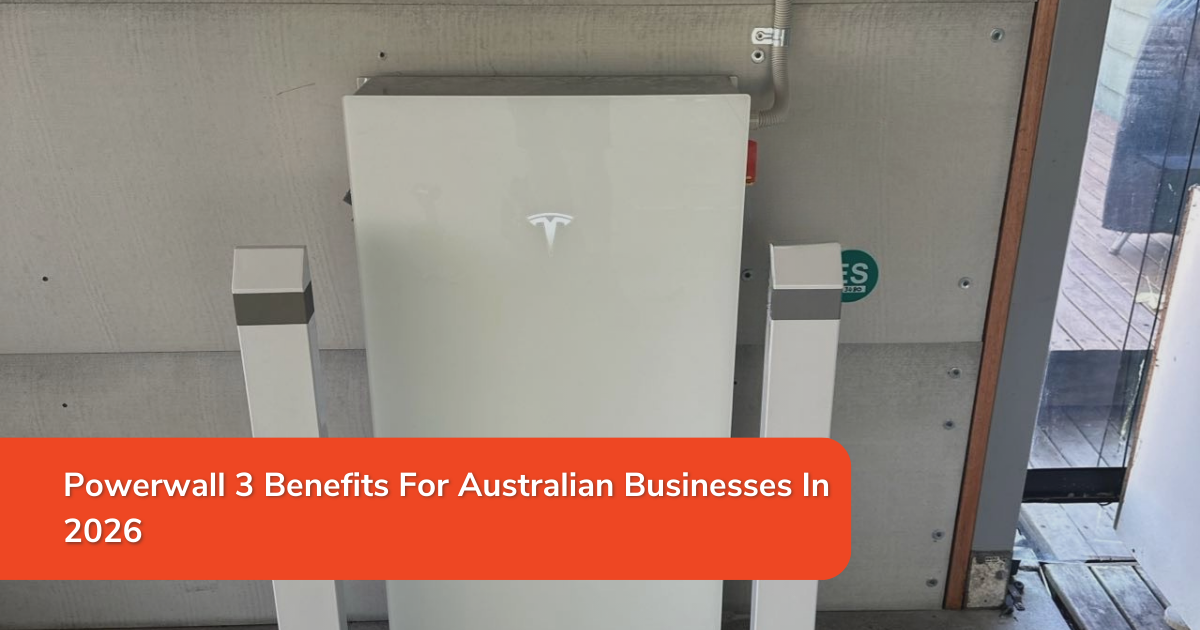
Tesla Powerwall 3 is the latest generation of Tesla’s energy storage technology, combining battery storage, inverter capability, and smart energy management in one streamlined unit.
Powerwall is primarily designed for homes, but it can suit some small businesses and mixed-use sites, especially where loads, backup needs, and site approvals align.
For businesses, this means:
Learn more about system specifications and installation options here: Tesla Powerwall 3 Solar Storage.
For many businesses, peak demand charges represent a major portion of electricity bills.
Demand charges apply on certain business tariffs and are based on the highest level of grid usage during a billing period, even if it only occurs for a short time.
Tesla Powerwall 3 can discharge stored energy during peak periods, helping businesses reduce grid demand and smooth consumption.
Over time, this approach can help lower electricity costs, particularly for businesses with fluctuating or seasonal loads.
Commercial rooftops are ideal for solar generation, especially when paired with high-efficiency modules such as the Aiko solar panel, which can deliver strong output even in limited roof space.
Without storage, excess solar power is often exported to the grid at low feed-in rates.
With Powerwall 3, businesses can store surplus generation and use it later, increasing solar self-consumption and improving overall system return.
This combination of Aiko solar panels and Tesla Powerwall 3 turns solar systems into full energy assets rather than simple generators.
Power outages can disrupt operations, affect safety systems, and lead to lost revenue.
Tesla Powerwall 3 offers seamless backup capability when configured correctly, ensuring critical systems remain operational during grid outages.
For businesses, this can mean:
Unlike traditional generators, Powerwall 3 provides silent, instant backup without fuel storage or manual intervention.
Commercial sites vary significantly in electrical configuration, particularly between single-phase and three-phase supply.
Backup capability is also a system design decision, such as essential-loads backup versus wider site backup.
This may require specific circuit design, switchboard work, and distributor approval.
Three-phase sites may require additional design considerations around backup circuits and approvals to ensure compliance and performance.
Common commercial setups include:
This scalability makes Tesla Powerwall 3 suitable for offices, retail sites, hospitality venues, warehouses, and mixed-use buildings where the site requirements are suitable.
As Australia’s energy market evolves, businesses with storage assets may be better positioned to participate in:
Powerwall supports app-based controls, including time-based modes, and may support VPP participation where available.
Participation is subject to retailer or programme eligibility and system configuration.
One of the most common questions business owners ask is about the Tesla Powerwall 3 price and how it compares to other storage options.
It is important to understand that the price of a Tesla Powerwall can vary depending on:
Rather than focusing purely on upfront cost, many businesses assess Powerwall 3 based on total cost of ownership.
This can include:
This approach provides a clearer picture of real value over the life of the system.
| Evaluation Area | What Commercial Buyers Should Assess | Why It Matters |
|---|---|---|
| Use case fit | Peak shaving, backup power, energy arbitrage, and VPP readiness | Ensures the system is sized and configured to match how the business actually uses energy. |
| Warranty and throughput | Warranty duration and total energy throughput limits | Determines how well the system supports commercial cycling over its usable life. |
| Scalability | Maximum supported units and modular expansion capability | Reduces risk as energy demand grows or site requirements change. |
| Backup architecture | Whole-site versus essential-load backup, changeover time, and load prioritisation | Aligns backup capability with business continuity and operational risk. |
| Safety and compliance | Compliance with relevant AS/NZS standards and certifications | Impacts approvals, insurance, and long-term site safety. |
| Support and monitoring | Local service availability, system monitoring, and response time expectations | Minimises downtime and protects operational reliability. |
| System integration | Compatibility with inverters, energy management systems, generators, and EV chargers | Enables efficient energy management and future system expansion. |
| Total cost of ownership | Installation, maintenance, degradation assumptions, and expected lifespan | Provides a realistic view of long-term value beyond upfront cost. |
For many Australian businesses, Tesla Powerwall 3 stands out for its balance of performance, reliability, and intelligent energy management.
Powerwall 3 can support peak shaving during busy periods, provide backup during outages, and improve energy cost predictability.
Stored solar energy can reduce grid dependence and support business sustainability goals.
High daytime loads paired with solar generation can make battery storage especially effective.
Each scenario can benefit from reduced costs, improved resilience, and better energy control.
Powerwall 3 may help reduce demand charges where the business is on a tariff that includes demand charges and the system is designed to discharge during peak demand periods.
Powerwall 3 may be used on some three-phase sites, but the final design depends on site configuration, backup requirements, distributor approvals, and compliance requirements.
Warranty and throughput terms help determine how suitable the system is for frequent commercial cycling over its usable life.
Businesses should review these details as part of the total cost of ownership assessment.
The Tesla Powerwall 3 price in Australia depends on system size, installation complexity, and whether solar is included.
Because of these variables, Tesla Powerwall prices are best assessed with a tailored quote rather than a fixed advertised cost.
Tesla Powerwall 3 is best suited for businesses that want:
The right system design always depends on your usage profile, site conditions, and business goals.
If you are exploring energy storage and want clarity around system sizing, installation requirements, or the Tesla Powerwall 3 price for your site, Smart Energy Answers can help you evaluate your options with confidence.
Learn more about Tesla Powerwall 3 solutions: Tesla Powerwall 3 Solar Storage.
Explore high-efficiency commercial solar options such as Aiko solar panels for larger rooftops.